


How Physicians and APPs Can Spot Recruiting Scams


If you're a physician, specialist, NP or PA, your inbox is probably full of job offers. Some are great. Some are not. And a growing number are recruiting scams.
Being in demand is a good thing. But the same things that make you valuable to employers make you valuable to scammers: a license, a high income and a public NPI number anyone can look up.
This guide covers how these scams work, the red flags to watch for, and how to check that a recruiter is real before you share anything.
Why scammers target clinicians
Job scams are growing fast. FTC reports of job and employment agency scams tripled from 2020 to 2024, and reported losses jumped from $90 million to $501 million (FTC). Overall, people reported losing $15.9 billion to fraud in 2025 (FTC).
Clinicians face extra risk for three reasons:
- Your details are public. Your NPI and state license number can be looked up by anyone. Scammers will cite them to sound official.
- Your credentials are worth stealing. A physician's identity can be used to apply for jobs. In one federal case, a man used licensed physicians' personal information to pose as a doctor with medical staffing firms.
- You're used to sharing paperwork. Credentialing asks for a lot of sensitive documents. Scammers count on you being used to it and not asking questions.
Common scams aimed at physicians and APPs
The fake recruiter.
Someone reaches out on LinkedIn, by text or by email about a high-paying role. They may claim to work for a real hospital or staffing firm. Health systems like Inova have warned that scammers posed as their recruiters on LinkedIn and Indeed to collect personal information.
The "credentialing fee."
You're told the job is yours once you pay for licensing help, background checks, malpractice coverage or a credentialing packet. A legitimate agency doesn't charge the clinician to place them.
The fake check.
You get a check to buy equipment or cover travel, then you're asked to send part of it back. The check bounces days later, and the money you sent is gone.
The identity grab.
The "recruiter" wants your Social Security number, date of birth, DEA number and license copies before you've talked about a specific job. The goal is your identity, not your placement.
The official-sounding threat.
This one isn't a job offer, but it often hits the same people. Callers pose as DEA agents or medical board staff and say your license is under investigation. The FBI has warned that physicians, NPs and PAs are all targets, and that scammers research you through practice websites and social media first. The DEA doesn't investigate medical licenses and can't revoke one by phone.
Red flags to watch for
- Pressure to move fast. "This role closes today" or "we need your documents in an hour." Real roles move quickly, but a good recruiter won't rush you past your own questions.
- Vague details. No facility name, no city, no schedule, no pay range after you’ve spoken with a recruiter. While job details may be masked in a public listing, real recruiters wil be able to tell you the job details.
- A request for money. Any fee to apply, credential, license or "hold" a position.
- Personal info up front. SSN, date of birth, bank details or DEA number before you've discussed a specific role and gotten job details.
- Odd channels. Interviews that are only by text or chat app, or a personal Gmail or Yahoo address instead of a company domain.
- A profile that doesn't hold up. A new LinkedIn account, few connections, a stock photo, or a firm with no real website.
- An offer with no conversation. A contract or offer letter before you've spoken with anyone live.
- Pay that's way out of line. Hot specialties pay well, so this one is tricky. But a rate far above market for an easy schedule deserves a second look.
How to check that a recruiter is real
It takes about five minutes.
- Look up the firm yourself. Find its website on your own, not through a link they sent. Check that the recruiter's email domain matches it.
- Call the main number. Use the number on the firm's website, not the one in the message. Ask if the recruiter works there.
- Check the LinkedIn profile. Look for a work history, real connections and a link to the company page.
- Ask for specifics. Facility, location, schedule, pay range, start date. A real recruiter will answer or tell you when they will be able to.
- Search the firm's name plus "scam" or "reviews." Pay attention to what comes up.
If anything doesn't check out, stop there. A real opportunity will still be there after you verify.
What a real recruiter will and won't ask for
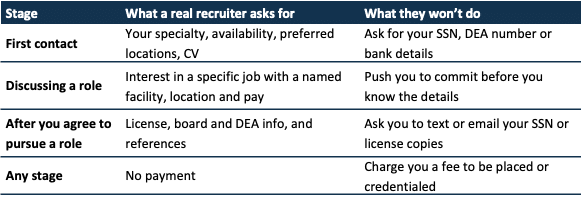
Here's the tricky part: a legitimate locum or perm recruiter will eventually need sensitive information. Credentialing requires it. The difference is timing and method.
If someone asks for credentialing-level information before you've talked about a real job, that's a red flag.
What to do if you've been targeted
- Stop responding. Don't call back numbers they gave you, and don't send anything else.
- Protect your money. If you paid or shared bank details, call your bank right away.
- Report it. File with the FTC at ReportFraud.ftc.gov and the FBI at ic3.gov. For a fake DEA call, also call the DEA Diversion hotline at 1-877-792-2873.
- Tell your state board. Let the state board know if someone impersonated the board or you think your license info is being misused.
- Warn the real company. If a scammer used a real firm's or hospital's name, let them know so they can alert others.
Work with recruiters you can verify
You're in demand. That gives you leverage, and it means you get to be picky about who you work with.
At Optigy, our recruiters will always tell you who they are, which role they're calling about and what it pays. You'll never pay us a fee, and we'll never ask for sensitive documents before you've decided a role is worth pursuing. Questions about whether a message is really from us? Contact us directly.


Related Articles